

 中文简体
中文简体
 English


What Is a High Force Pneumatic Cylinder and When Do You Actually Need One?
A high force pneumatic cylinder is an air cylinder engineered to deliver substantially greater output thrust than standard bore cylinders — typically producing forces ranging from 5,000 N to over 200,000 N — by combining large bore diameters, elevated operating pressures, or tandem/multi-stage configurations. If your application involves pressing, clamping, punching, forming, or heavy lifting where a conventional air cylinder simply cannot sustain the required load, a high force pneumatic cylinder is the direct answer.
The decision to use a high force air cylinder over a hydraulic alternative often comes down to cleanliness, speed, and maintenance simplicity. Pneumatic systems operate with compressed air, meaning no oil contamination risk, faster cycle times, and easier compliance with food, pharmaceutical, or cleanroom standards. The trade-off is force density: hydraulic cylinders generate higher force per unit area, but when air pressure at 10 bar is sufficient — which it is for most industrial clamping and pressing tasks up to roughly 100 kN — a large bore pneumatic cylinder delivers that force reliably and cost-effectively.
How a Pneumatic Cylinder Generates High Force: The Physics Behind the Numbers
Force output from any air cylinder is calculated by a straightforward formula: F = P × A, where F is force in Newtons, P is gauge pressure in Pascals, and A is the effective piston area in square meters. This means two levers are available to the design engineer: increase pressure, or increase bore size.
Consider a 200 mm bore air cylinder operating at 6 bar (600,000 Pa). The piston area is approximately 0.0314 m², giving a theoretical push force of 18,850 N — just under 1.9 tonnes. Scaling the bore to 320 mm at the same pressure yields 48,254 N, nearly 4.9 tonnes. Raising pressure to 10 bar on the same 320 mm bore brings the theoretical output to 80,425 N. These numbers illustrate why bore diameter is the primary variable engineers manipulate when specifying a high force pneumatic cylinder.
Pull force (retraction stroke) is always lower than push force because the rod displaces cross-sectional area on the cap side. For a 320 mm bore cylinder with a 100 mm rod at 10 bar, the pull force drops to approximately 72,600 N — still formidable, but an important distinction for applications where retraction must hold a load.
Tandem Cylinder Configurations
When a single bore cannot deliver sufficient force within space or pressure constraints, tandem air cylinders stack two or more pistons on a single rod. Each piston contributes its thrust, and the forces sum directly. A tandem arrangement of two 250 mm bore cylinders at 8 bar produces roughly 78,500 N combined — equivalent to a single 350 mm bore unit — while keeping the physical footprint narrower. Tandem configurations are common in automotive stamping fixtures and precision press-fit operations.
- F — Output force (N)
- P — Supply pressure (Pa)
- A — Piston area (m²)
- D — Bore diameter (m)
Types of High Force Pneumatic Cylinders and Their Industrial Applications
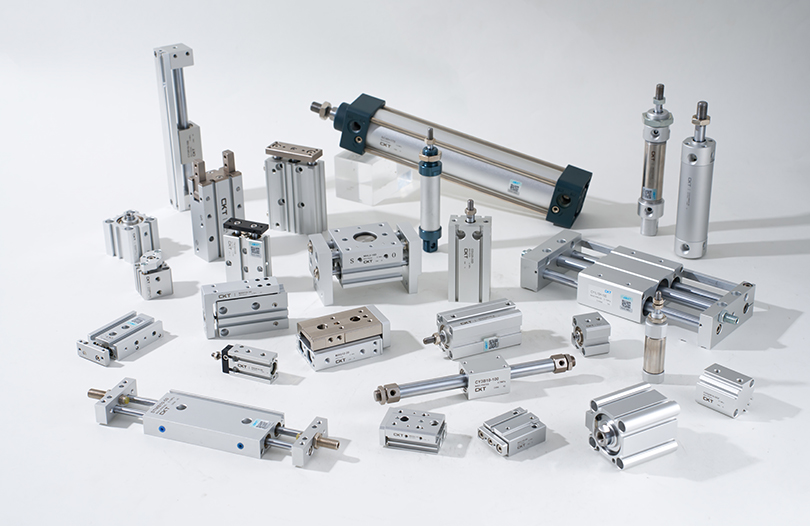
Not every high force air cylinder serves the same purpose. The variety of configurations available reflects the breadth of demanding applications across manufacturing, processing, and automation industries. Understanding which cylinder type fits which task prevents costly over-specification or, worse, under-powered installations that fail prematurely.
Large Bore Single-Acting Cylinders
Spring-return or gravity-return designs with bores up to 320 mm. Used in clamp-and-hold operations, gate valves on pipelines, and injection mold clamping where the working stroke only needs power in one direction. Air consumption per cycle is halved compared to double-acting equivalents, which matters at high cycle frequencies.
Large Bore Double-Acting Cylinders
The most common high force pneumatic cylinder category. Pressurized air acts on both sides of the piston, providing powered extension and retraction. ISO 15552 standard cylinders are available from 32 mm to 320 mm bore in catalog form, with custom manufacturing extending beyond 500 mm bore. Automotive body-in-white lines routinely deploy 250 mm bore double-acting cylinders for panel pressing.
Tandem Cylinders
Two pistons on a shared rod in a single body. Force output approximately doubles without increasing bore size. Ideal where envelope width is constrained but axial length is available. A 160 mm bore tandem unit at 8 bar delivers roughly 32,170 N — comparable to a single 225 mm bore cylinder — in a body only marginally longer than a standard double stroke unit.
Rodless Cylinders (Large Bore)
The piston drives an external carriage via a sealed slot or magnetic coupling instead of a protruding rod. Allows stroke lengths equal to the cylinder body length, making them compact for long-travel high force applications such as material transfer in stamping lines or press-brake back gauges with forces up to 15,000 N.
Pneumatic Hydraulic Intensifier Systems
These hybrid units use a large-bore air cylinder to drive a small-bore hydraulic piston, multiplying force by the ratio of piston areas. A 200 mm pneumatic stage driving a 40 mm hydraulic stage at 6 bar inlet produces hydraulic output pressures exceeding 150 bar, enabling forces well above 200,000 N. Used in spot welding guns, riveting machines, and clinching tools.
Short Stroke High Force Cylinders
Sometimes called pancake or flat cylinders, these deliver very high clamping force over strokes of 5–50 mm. Bore diameters of 250–400 mm in very short bodies generate forces up to 125,000 N in minimal axial space. Used in fixture clamping, die setting, and pallet locating on machining centers.