

 中文简体
中文简体
 English


Content
The Critical Role of the GR Series Pressure Regulating Valve in Air Preparation
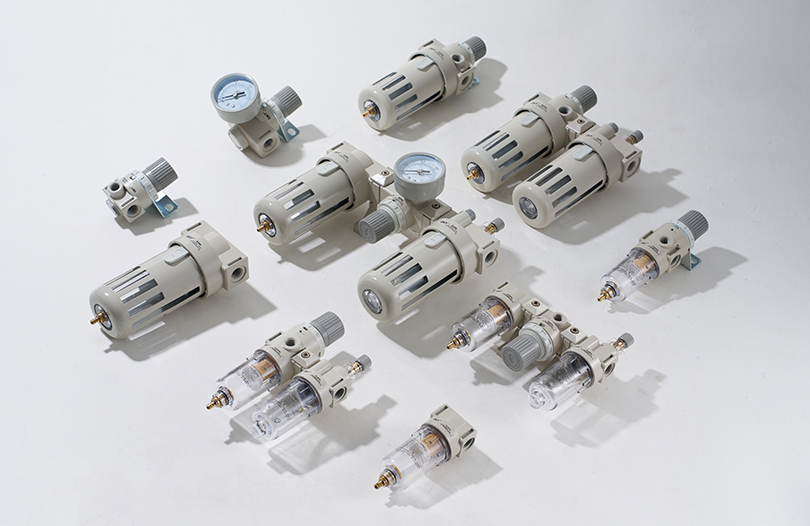
In any high-performance pneumatic system, the consistency of air pressure is the foundation of operational success. The GR Series Pressure Regulating Valve, a core component of the Modular F.R.L. Units G Series, is designed to provide this exact stability. For engineers and maintenance professionals, fluctuating air pressure can lead to erratic machine behavior, increased wear on actuators, and inconsistent product quality. By integrating the GR Series, facilities can achieve a level of control that directly translates to a 20% improvement in pneumatic component longevity.
One of the most immediate advantages of the Pressure Regulating Valve is its intelligent physical design. In modern machinery where every millimeter of space is accounted for, the embedded square pressure gauge is a game-changer. This integrated feature is used to save installation space significantly, removing the bulky protrusions common with traditional external gauges. For those who prefer classic monitoring, the system remains flexible as an external round pressure gauge can also be used, catering to diverse aesthetic and functional preferences on the factory floor.
Unmatched Stability Through Advanced Balanced Design
Pressure Self-Locking for Operational Security
A frequent concern in busy industrial environments is the accidental adjustment of pressure settings due to vibration or human error. The GR Series effectively eliminates this risk with its pressure self-locking structure. Once the desired pressure is set, the locking mechanism ensures the setting cannot be disturbed by external factors. This is particularly vital in precision applications like semiconductor packaging or pharmaceutical labeling, where even a 0.05MPa deviation can result in costly batch errors.
Balanced Adjustment Mechanism
What truly sets the Modular F.R.L. Units G Series apart is the internal engineering of the adjustment dial. The pressure adjustment mechanism adopts a balanced design. This sophisticated approach makes the pressure adjustment more stable, ensuring that the output pressure remains constant regardless of fluctuations in the inlet supply. Users will experience small drift and excellent pressure characteristics, which are essential for maintaining the high-speed cycle rates of modern Pressure Regulating Valve applications.
Versatility in Mounting and specialized Air Requirements
System integration is made seamless through multiple hardware configurations. While many regulators are limited to a single mounting style, the GR Series provides two distinct options. In addition to standard panel installation for a clean control-room look, fixed bracket installation can be selected for rugged, on-machine mounting. This adaptability allows the Pressure Regulating Valve to be deployed in both stationary factory settings and mobile pneumatic units with equal stability.
Furthermore, the product range extends beyond high-pressure needs. For sensitive applications requiring delicate force control—such as light-duty clamping or air-cushioning—a low-pressure type is also available. This specialized version has a maximum adjustable pressure of 0.4MPA, providing much finer resolution for low-range tasks. By offering these diversified forms, the GR Series ensures it can meet the specific pressure demands of any automated workflow.
| Technical Feature | Design implementation | Industrial Benefit |
|---|---|---|
| Visual Monitoring | Embedded Square Gauge | Streamlined profile & saved space |
| Stability Logic | Balanced Internal Design | Low pressure drift & high precision |
| Setting Protection | Self-Locking Mechanism | Prevents accidental pressure changes |
| Pressure Range | Standard & Low-Pressure (0.4MPa) | Adaptable to various sensitivity needs |
Maximizing System Performance with the G Series Modular F.R.L. Units
The GR Series Pressure Regulating Valve is most effective when used as part of a complete Modular F.R.L. Units G Series assembly. In this configuration, the regulator works in tandem with filters and lubricators to ensure the air is not only at the correct pressure but also clean and adequately conditioned for downstream valves and cylinders. The modularity of the G series allows for rapid disassembly and maintenance, ensuring that if a seal needs replacing or a gauge needs recalibration, the downtime is measured in minutes rather than hours.
Leading manufacturing plants that have implemented the GR Series report a significant reduction in waste. By maintaining a stable Pressure Regulating Valve output, machines operate at peak efficiency with fewer mechanical shocks caused by over-pressurization. This level of reliability is what makes the G Series an industry standard for companies looking to modernize their pneumatic infrastructure.
Frequently Asked Questions (FAQ)
Why should I choose the embedded square pressure gauge over an external one?
The embedded square pressure gauge is designed to save installation space and provide a more compact, streamlined appearance. It also reduces the risk of the gauge being hit or damaged during machine operation compared to an external round gauge.
How does the self-locking structure work?
The pressure self-locking structure allows the user to set the pressure and then lock the adjustment knob in place. This prevents the set pressure from being disturbed by external factors such as machine vibrations or accidental tampering.
What is the benefit of the balanced pressure adjustment design?
The balanced design ensures that the pressure adjustment is more stable. It minimizes the effect of inlet pressure variations on the output, resulting in small drift and good pressure characteristics for consistent pneumatic performance.
When should I use the low-pressure type GR valve?
The low-pressure type, with a maximum adjustable pressure of 0.4MPA, is ideal for applications requiring high sensitivity and precise control at lower air volumes, such as in laboratory automation or delicate material handling.