

 中文简体
 English


Content
- 1 Start With the Duty, Not the Material
- 2 How to Size a Stainless Steel Cylinder in Four Numbers
- 3 Which Stainless Cylinder Families Cover Which Jobs
- 4 Seals, Media and Temperature Limits That Decide Service Life
- 5 Mounting, Alignment and the Failures That Follow Misalignment
- 6 Pneumatic or Electric: Where Stainless Air Cylinders Still Win
- 7 Maintenance Intervals Backed by Real Cycle Numbers
- 8 Procurement Checklist Before You Order
- 9 Frequently Asked Questions About Stainless Steel Pneumatic Cylinders
- 9.1 Is a stainless cylinder completely stainless, including the rod and the screws?
- 9.2 Can the cylinder itself handle water or cleaning fluid as its working medium?
- 9.3 What bore do I need to lift a 20 kg load vertically?
- 9.4 Is 316 worth the extra cost over 304?
- 9.5 Why does a brand new 304 barrel sometimes attract a magnet?
- 9.6 How long should a stainless cylinder last in a daily washdown cell?
- 9.7 Do stainless cylinders need a lubricator?
Stainless steel pneumatic cylinders earn their price in a narrow, predictable set of conditions: the actuator gets hosed down, sprayed with cleaning foam, or wiped with chemistry during every shift, or it lives in humid, salty or acidic air where plated steel and anodised aluminium start to pit within months. When those conditions are real, the extra cost comes back quickly, because a corroded cylinder is not a cosmetic problem. A pitted barrel scores the piston seal, the rod seal starts weeping, and the machine that depended on that cylinder stops at the worst possible hour.
On a typical stainless cylinder, four areas decide whether the part survives: the barrel, the two end caps, the piston rod, and the hardware that ties everything together, meaning tie rods, nuts, brackets, cushion screws and the fittings screwed into the ports. Manufacturers often mix materials inside a single part number. A cylinder can have a stainless barrel, an anodised aluminium cap and a carbon steel lock nut on the rod, and that mix is exactly where corrosion starts, because a galvanic pair needs only a thin film of water to begin working.
A concrete case shows the pattern. A 32 mm bore, 80 mm stroke cylinder on a nozzle-lift axis in a dairy filling hall ran at 40 cycles per minute in a zone sprayed with alkaline foam twice a day. The aluminium version of the same cylinder needed a rod seal replacement at roughly five months, and the rod showed rust freckles within weeks. A stainless version of the same bore and stroke ran past two years on its original seals. Nothing about the mechanics changed. Only the environment and the material did.
Start With the Duty, Not the Material
The conclusion first: specify stainless when the environment attacks metal, not because the catalogue page looks more robust. The practical triggers are short and specific.
- The cylinder is washed with water, foam, or an alkaline or acidic cleaner at least once a day.
- Clean-in-place routines run at elevated temperature, commonly between 60 and 85 degrees Celsius.
- The machine handles food, dairy, beverage, cosmetic or pharmaceutical product in open condition.
- The site is coastal, floating, or otherwise exposed to salt and chloride mist.
- Acid or alkali vapour is present, for instance near pickling, plating or battery assembly work.
- The actuator sits outdoors or in a wet cellar where condensation forms on cold metal overnight.
Skip stainless, or restrict it to the rod and the hardware, when the equipment sits in a dry, filtered and temperature-controlled hall, when a machine shop runs without coolant mist, or when high cycle rates make the lower moving mass of aluminium more valuable than corrosion resistance. A dry indoor cell rarely justifies the premium, and the money is better spent on filtration and a dryer.
Once stainless is the answer, the next question is the grade, because 304 and 316 behave differently in chloride and acid service.
| Grade | Typical composition | Chloride and acid resistance | Relative material cost index | Typical duty |
|---|---|---|---|---|
| 304 | About 18 percent chromium, 8 percent nickel, no molybdenum | Good in fresh water and most washdown chemistry, pits in chloride-rich or strongly acidic conditions | 1.0 | General washdown, packaging, dry food handling |
| 316 and 316L | 16 to 18 percent chromium, 10 to 14 percent nickel, 2 to 3 percent molybdenum | Noticeably better against chlorides and acids, the usual choice for clean-in-place chemistry and coastal air | Commonly 1.2 to 1.5 times the 304 index | Dairy, seafood, pharmaceutical, marine and offshore |
How to Size a Stainless Steel Cylinder in Four Numbers
Four numbers decide whether the cylinder works with the machine or fights it: required thrust, bore, stroke and air consumption. Get the thrust wrong and the cylinder stalls mid-stroke. Get the air consumption wrong and the compressor becomes the bottleneck of the whole line.
Bore and thrust
Thrust follows one relationship: force equals gauge pressure multiplied by effective piston area, multiplied by an efficiency factor that covers seal friction and internal losses. For general-purpose cylinders, use about 0.85 on the extending stroke. A 6 bar supply into a 32 mm bore gives a theoretical 482 N and a working figure near 410 N. The retracting stroke loses the rod area, so a 32 mm bore with a 12 mm rod returns roughly 415 N theoretical and about 350 N working.
Stroke, cushioning and load ratio
Keep stroke close to the travel the mechanism actually needs, plus a few millimetres of adjustment. A long unsupported stroke invites rod buckling and vibration, so the rod diameter should be large enough that the buckling load stays at least four times the working thrust. Above roughly 500 mm of stroke, step up one bore size or add a guide. Cushioning matters as much as the bore: air cushioning is adjustable and suits most loads, rubber bumpers are simpler and quieter, and heavy or fast-moving masses deserve a separate hydraulic buffer.
If you want the deeper background on how force, cushioning and load ratio interact inside a barrel, our note on how pneumatic cylinders turn air pressure into usable force covers the same physics in more detail.
| Bore (mm) | Piston area (mm2) | Thrust at 5 bar (N) | Thrust at 6 bar (N) | Working load at 6 bar (N) |
|---|---|---|---|---|
| 16 | 201 | 101 | 121 | 103 |
| 20 | 314 | 157 | 189 | 160 |
| 25 | 491 | 245 | 295 | 251 |
| 32 | 804 | 402 | 483 | 410 |
| 40 | 1257 | 628 | 754 | 641 |
| 50 | 1963 | 982 | 1178 | 1001 |
| 63 | 3117 | 1559 | 1870 | 1590 |
Air consumption and running cost
Air consumption is easy to underestimate. Take the same 32 mm bore with a 100 mm stroke at 6 bar. The extending stroke sweeps about 0.080 litres and the retracting stroke about 0.069 litres, so the cylinder moves roughly 0.15 litres of compressed air per cycle. Expanded to free air at 6 bar gauge, that is about 1.05 litres per cycle. Nobody pays attention to one litre. At 30 cycles per minute across eight cylinders, the circuit consumes around 15 cubic metres of free air per hour, which is roughly 1.5 kWh of compressor energy per hour at a typical specific power near 0.1 kWh per cubic metre.
Which Stainless Cylinder Families Cover Which Jobs
Miniature and compact stainless cylinders
Small stainless actuators do most of the work in wet zones: picking, clamping, ejecting and gate opening. Families such as the CJ2 and CM2 mini cylinders, together with the MA and MI series, use stainless barrels and rods across a bore range that typically runs from about 6 mm up to 40 mm, with strokes from 15 mm to a few hundred millimetres. Single-acting versions suit simple push-only motions and save a valve port; double-acting versions give control in both directions and are the safer default when the load must return against gravity.
 CM2 Series Stainless Steel Mini Cylinder (Double Acting)CM2 Series Stainless Steel Mini Cylinder (Double Acting) is a compact stainless steel actuator designed for space-constrained working conditions. It has a double-actin...View Product →
Inside a washdown cell, the useful check is not the bore but the small print: whether the end caps are the same grade as the barrel, whether the rod end thread and lock nut are stainless, and whether the cushion screw will still turn after six months of caustic foam.
Larger bores and guided variants
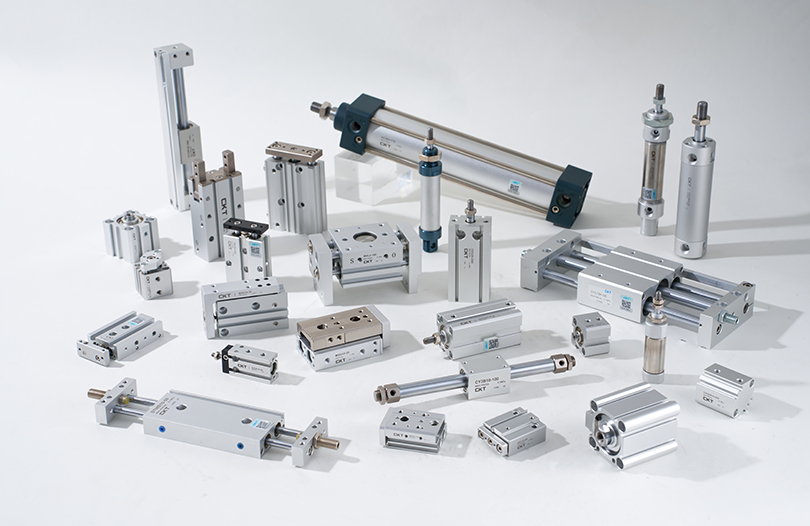
Above about 40 mm bore, most general-purpose cylinders use an anodised aluminium barrel with a stainless rod and stainless fasteners, because the weight and cost of a solid stainless barrel grow quickly. That is a workable compromise in splash zones, provided every exposed screw and bracket is also stainless. Thin cylinders, guided cylinders with a rod anti-rotation feature, slide cylinders on linear guides, compact multi-axis types and rotary cylinders all follow the same rule. If a load hangs off the rod, use a guided or slide design rather than fighting the side load. The wider pneumatic cylinder range splits neatly into these families, from mini and thin types up to rodless and gripper designs.
Seals, Media and Temperature Limits That Decide Service Life
The stainless body will outlast several sets of seals, so the seal compound is the real service-life limit. Standard nitrile rubber covers roughly minus 10 to 80 degrees Celsius and handles ordinary filtered air and most washdown splash. Fluorocarbon seals push the ceiling towards 150 degrees Celsius and resist more aggressive chemistry, at a higher price. EPDM appears mostly in fluid-handling valves where water and hot rinse media flow through the body rather than driving a piston.
Air quality matters just as much as the grade of steel. Water carried into the barrel washes the grease film off the seals, promotes corrosion on internal springs and swells some elastomers, and stainless does not behave better here than aluminium. Standard practice for a washdown cylinder is filtration at 5 micrometres, a dew point low enough that liquid never forms inside the lines, and only minimal oil carryover. Most modern cylinders are designed to run without a lubricator, and adding oil mist to a line that never needed it can flush existing grease out of older valves downstream.
 2S Series 2 Position 2 Way Stainless Steel Solenoid Valve2S Series 2 Position 2 Way Stainless Steel Solenoid Valve is a core component designed for fluid control systems. It plays a key role in industrial automation with its...View Product →
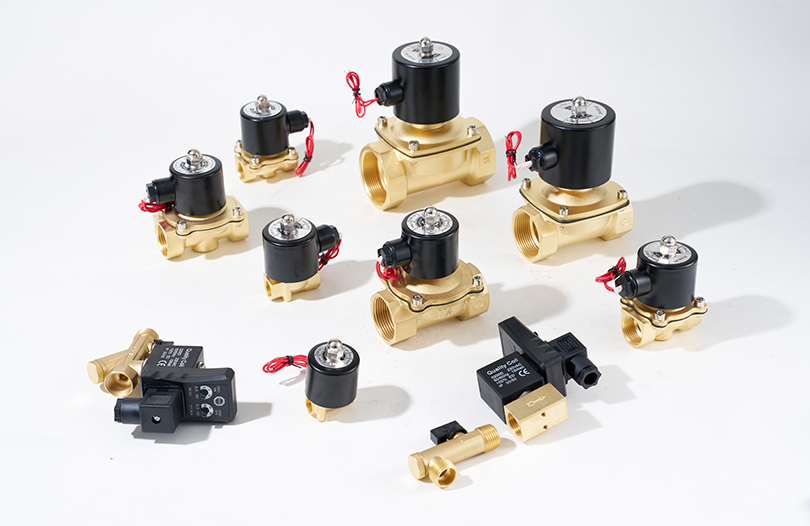
Where the machine also has to switch the rinse water, a cooling stream or a light oil in the same wet area, the stainless two-port fluid valve family is the usual companion to the actuators, because the same environment that pits a cylinder body will pit a brass valve body just as fast.
Mounting, Alignment and the Failures That Follow Misalignment
Most premature failures blamed on material are actually alignment problems. On small bores, aim for parallel offset within about 0.05 mm and angular error under half a degree; larger bores tolerate slightly more, but not a great deal more. A clevis or flange mount that is bolted square to a misaligned load will bend the rod a fraction of a millimetre per stroke, and a million strokes later the rod seal has an oval wear pattern and starts to weep.
Hardware deserves the same attention as the barrel. A stainless cylinder connected with plated steel fittings and a carbon steel bracket will show rust streaks at exactly the joints that customers notice first. Stainless one-touch fittings in 304 and in SUS316 cover the common tube sizes, and the choice between them follows the same chloride logic as the cylinder body. Tubing matters too: polyurethane holds up well in ordinary washdown, while fluoropolymer tubing is the safer option around solvent-based cleaners.
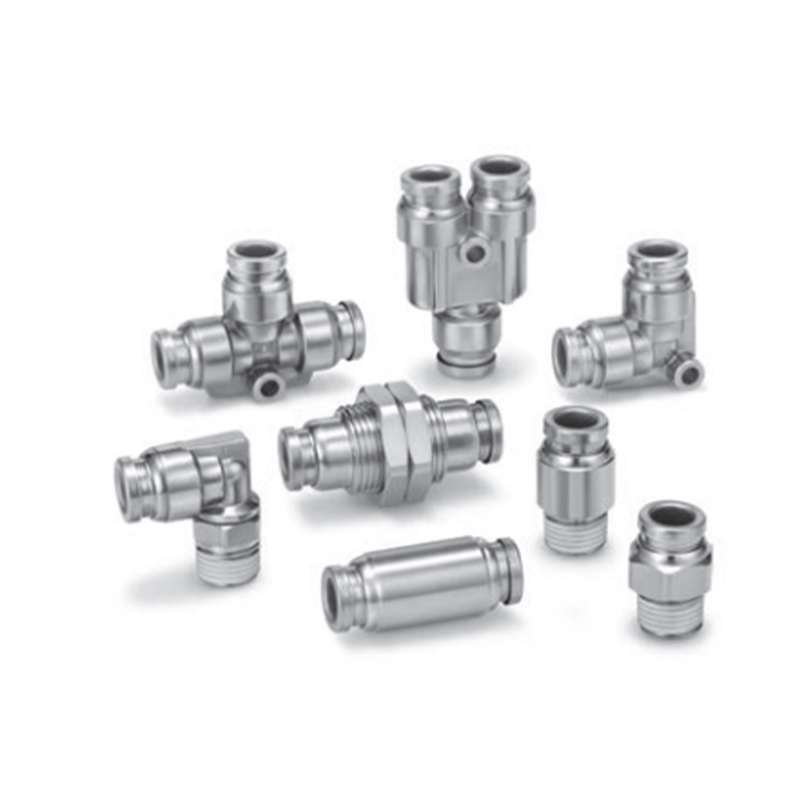 KQG2 Series SUS316 Stainless Steel one touch fittingKQG2 series SUS316 stainless steel one touch fittings are designed for harsh industrial environments. They are made of surgical instrument grade SUS316 stainless steel...View Product →
| Symptom | Most likely cause | Practical fix |
|---|---|---|
| Rod seal weeping within the first months | Side load, misalignment, wet air | Realign the mount, add a floating joint, dry the air with a refrigerated dryer |
| Piston drifts or drops without a signal | Worn piston seal or leaking valve spool | Replace the seal kit, check the valve, add a pilot check valve for vertical axes |
| Loud knock at end of stroke | Cushion screw wide open or oversized moving mass | Close the air cushion by about one turn, fit a hydraulic buffer for heavy loads |
| Read switch misses short strokes | Switch positioned outside the magnet band | Reposition the switch in the middle of the sensing band and lock the screw |
Pneumatic or Electric: Where Stainless Air Cylinders Still Win
Electric actuators took over the positioning jobs on many lines, but stainless air cylinders keep three advantages in wet duty. First, force per unit of purchase price remains high, and a pneumatic axis carries no risk of water ingress into motor windings or encoder housings. Second, they tolerate heat, vibration and repeated washdown without electronic protection ratings becoming a design debate. Third, they fail in a predictable way, usually by slowing down or drifting rather than stopping with an error code that halts the whole cell.
The trade-off is energy. Running the eight-cylinder example above costs roughly 1.5 kWh per hour, or around 9,000 kWh over 6,000 production hours a year, before any leakage. A single 1 mm hole in a 6 bar line leaks about 1.2 litres of free air per second, close to 4.3 cubic metres per hour, which is enough to add several hundred dollars of compressor energy over a year. Fixing leaks is usually cheaper than converting a washdown axis to electric.
Maintenance Intervals Backed by Real Cycle Numbers
Seal life is better measured in travel distance than in calendar time. Published seal-life curves for general-purpose cylinders typically fall between 2,000 and 5,000 km of piston travel when the air is clean, dry and unlubricated, and the lower half of that range applies when air quality slips or the rod runs warm. Convert the distance into production time and the plan writes itself.
- 30 cycles per minute, 100 mm stroke, 16 hours a day, 300 days a year equals 8.64 million strokes and about 1,728 km of travel each year.
- At that rate, plan a seal kit at roughly 18 to 24 months, and keep one kit per critical cylinder on the shelf.
- Inspect the rod for scoring, verify the cushion setting, and check mounting bolt torque every quarter.
- Replace the dryer element on schedule; moisture does more damage to a seal than a stainless barrel will ever prevent.
The stainless body itself rarely needs replacement. In most wet-duty plants, the barrel outlives three seal sets, which is precisely why the material decision should be made once and made properly.
Procurement Checklist Before You Order
Bring these points to the quotation stage, because each one changes the part number and often the lead time.
- Confirm bore, stroke and the required working thrust, including the efficiency factor.
- State the grade for the barrel, end caps, rod and fasteners, and ask whether mixed materials appear in the bill of materials.
- Choose the seal compound against the actual cleaning chemistry and temperature range.
- Decide cushioning: adjustable air cushion, rubber bumper, or an external hydraulic buffer for heavy loads.
- Specify mounting style and whether a floating joint or self-aligning clevis is required.
- Match port threads and rod threads to the existing fittings so retrofits do not need adapters.
- Select magnetic switches with a sealed housing if the switch sits inside the wash zone.
- Ask for the seal kit part number and confirm it will still be available in three years.
- Record the air quality at the point of use, since it decides whether the seal-life figure on the datasheet applies.
- Quantify spare coverage for the critical axes, not for the whole plant average.
Frequently Asked Questions About Stainless Steel Pneumatic Cylinders
Is a stainless cylinder completely stainless, including the rod and the screws?
Rarely, unless you specify it. The barrel and often the rod are stainless, but tie rods, lock nuts, cushion screws, brackets and fittings may still be plated steel or zinc alloy. Ask for the material of every exposed item, because those small parts are the first to rust and the first thing a customer sees during an audit.
Can the cylinder itself handle water or cleaning fluid as its working medium?
No. A pneumatic cylinder is designed for filtered compressed air, and water inside the barrel damages seals and springs. When the process fluid has to be switched, use a dedicated two-port fluid valve in the same stainless material and keep the actuator on air. Mixing the two duties is a common and expensive mistake.
What bore do I need to lift a 20 kg load vertically?
A 20 kg load needs about 196 N just to hold position, and a practical design adds a safety margin, so plan for roughly 300 N of usable thrust. At 6 bar with the 0.85 efficiency factor, that requires about 590 square millimetres of piston area, which points to a 32 mm bore. A 25 mm bore would be marginal at 251 N of working thrust once acceleration is included.
Is 316 worth the extra cost over 304?
Yes in chloride-rich, acidic or coastal duty, where 304 tends to pit at weld seams and threads. In ordinary fresh-water washdown with neutral or mildly alkaline chemistry, 304 performs well for years, and the price difference is real. Choose the grade from the cleaning agent and the water chemistry, not from a general preference.
Why does a brand new 304 barrel sometimes attract a magnet?
Cold drawing and machining change the crystal structure of austenitic stainless steel slightly, so a mild magnetic response is normal and does not mean the part is carbon steel. A strong attraction across the whole surface is a different story, and worth checking against the mill certificate before you accept the shipment.
How long should a stainless cylinder last in a daily washdown cell?
Expect the body and rod to last many years, with seal replacement based on travel distance rather than the calendar. In continuous three-shift duty, plan on a seal kit every 18 to 24 months and a rod inspection every quarter. If seals fail faster than that, look at air quality and alignment before blaming the material.
Do stainless cylinders need a lubricator?
Most modern designs run without one. Adding oil mist to a line that was never lubricated can wash the factory grease out of the piston seal and push oil downstream into valves and sensors. If a plant standard already includes lubrication, stay consistent and lubricate every cylinder on that line rather than mixing practices.
Stainless steel pneumatic cylinders are a straightforward engineering answer to a specific problem: metal that has to survive water, chemistry and chloride without turning into a maintenance item. Choose the grade from the cleaning routine, size the bore from the real thrust requirement with a margin, protect the seals with dry and filtered air, and align the mount so the rod never bends. Do those four things and the cylinder becomes the least interesting part of the machine, which is exactly what a production team wants.
Zhejiang CKT Pneumatic has been building pneumatic components since 2002, with a brand registered in 2005, and brought multi-series cylinder production into mass manufacture in 2013. With more than 20,000 component types and over 90 percent of parts machined in house, the company can match stainless mini cylinders, fittings, fluid valves and accessories from one supply chain, which shortens both the selection stage and the spare-parts conversation later on.