

 中文简体
中文简体
 English


Content
- 1 The Pneumatic Cylinder Barrel Is Where Cylinder Quality Actually Lives
- 2 What the Cylinder Barrel Actually Does Inside an Air Cylinder
- 3 Barrel Materials Compared: Aluminum, Steel, and Stainless Steel
- 4 Common Pneumatic Cylinder Barrel Cross-Sections
- 5 How a Pneumatic Cylinder Barrel Is Manufactured
- 6 Key Tolerances and Surface Specifications for a Pneumatic Cylinder Barrel
- 7 Selecting the Right Pneumatic Cylinder Barrel for Your Application
- 8 What to Evaluate When Sourcing Cylinder Barrels from a Manufacturer
- 9 Frequently Asked Questions About Pneumatic Cylinder Barrels
- 9.1 Is a pneumatic cylinder barrel the same as a cylinder tube?
- 9.2 Why is the inner surface of an aluminum cylinder barrel honed or roller-burnished?
- 9.3 Can I replace a steel cylinder barrel with an aluminum one?
- 9.4 What does a Mickey Mouse pneumatic cylinder barrel look like?
- 9.5 How do I measure the bore of a pneumatic cylinder barrel?
The Pneumatic Cylinder Barrel Is Where Cylinder Quality Actually Lives
If you only remember one thing about pneumatic cylinder barrels, keep this: the barrel defines the pressure rating, motion smoothness, and service life of an air cylinder. The piston slides inside it, the seals ride against its inner wall, and every load cycle stresses its structural stiffness. A barrel with poor roundness, a rough honed surface, or the wrong wall thickness creates air leaks, speed fluctuation, and premature seal wear long before the rest of the cylinder shows visible damage.
For most industrial applications, an aluminum pneumatic cylinder barrel with an anodized or precision-finished bore is the best balance of weight, corrosion resistance, cost, and machinability. For high-temperature, washdown, or food-contact environments, a stainless steel pneumatic cylinder tube is the safer choice. The material and internal finish are more important than the cylinder brand or the colour of the anodizing.
Bottom line: when you evaluate a pneumatic cylinder barrel, do not look at the outer profile first. Look at the bore tolerance, surface roughness, straightness, and the manufacturing process behind the inner surface. Those parameters determine how the cylinder behaves under load and how many cycles it survives.
What the Cylinder Barrel Actually Does Inside an Air Cylinder
The pneumatic cylinder bore is the main body and pressure vessel of the cylinder. It houses the piston and keeps compressed air inside the working chamber. If you understand the five roles below, you will understand why barrel quality affects the whole actuator.
- Pressure containment. The barrel wall must resist the internal pneumatic pressure without excessive radial expansion. Cylinders working at 1 MPa need a thicker or stronger barrel than cylinders working at 0.3 MPa.
- Piston guidance. The inner diameter of the barrel guides the piston and piston rod assembly. If the bore is oval, the piston tilts during movement and creates uneven seal contact.
- Sealing partner. The piston seal slides against the barrel inner wall. A smooth, consistent surface is essential for low friction, stable speed, and long seal life.
- Heat dissipation. Aluminum barrels conduct heat away from the compression chamber faster than steel, which helps stabilise temperature during rapid cycling.
- Structural connection. In tie-rod cylinders, the barrel is compressed between the end caps by four or more bolts. The barrel must keep its geometry after that axial clamping force is applied.
The barrel also determines how easily a cylinder can be repaired. A damaged seal can be replaced, but a damaged barrel usually means the whole cylinder must be scrapped. This is why manufacturers who control the barrel finishing process, such as pneumatic cylinder manufacturers that focus on internal barrel quality, tend to deliver more consistent actuators over a long production run.
Barrel Materials Compared: Aluminum, Steel, and Stainless Steel
Most pneumatic cylinder barrels are made from 6xxx series aluminum alloys because they extrude well and can be anodized. Steel barrels appear in heavy-duty tie-rod cylinders where impact resistance and high-pressure strength matter. Stainless steel barrels are reserved for corrosive environments. The table below summarises the practical differences for buyers and design engineers.
| Material | Typical finish | Best use case | Watch out for |
|---|---|---|---|
| Aluminum 6063 / 6061 | Honed or roller-burnished bore, anodized outer surface | Standard automation cylinders, compact and mini cylinders | Low resistance to harsh chemicals and strong impact |
| Carbon steel | Honed, sometimes hard-chrome plated inside | Heavy-duty tie-rod cylinders, high-pressure lines | Heavier, requires corrosion protection |
| Stainless steel 304 / 316 | Honed or polished bore | Food, pharmaceutical, washdown, marine applications | Higher cost and lower heat conductivity |
Anodizing depth is a practical specification to check. Typical sulfuric acid anodizing on aluminum cylinder barrels is about 8 to 15 microns; hard anodizing can reach 25 to 50 microns. For sliding applications, hard anodizing improves wear resistance, but the bore is often finished before or after coating, depending on the required final tolerance.
Common Pneumatic Cylinder Barrel Cross-Sections
Barrel profile shapes follow the cylinder geometry they belong to. You will see four families of profiles in industrial catalogs: round, square, compact, and guided or multi-axis profiles. Each one exists for a different mounting or space reason.
Round tie-rod barrels
The classic round barrel is found in SC series tie-rod cylinders. Four tie rods clamp the barrel between two end caps, so the barrel itself does not need a flange. This design is easy to service because the barrel can be replaced separately. It is also the most common configuration for bore sizes from 32 mm to 320 mm. If you need a standard, globally interchangeable cylinder, look for SC tie-rod pneumatic cylinders with an aluminum barrel and a precision-finished bore.
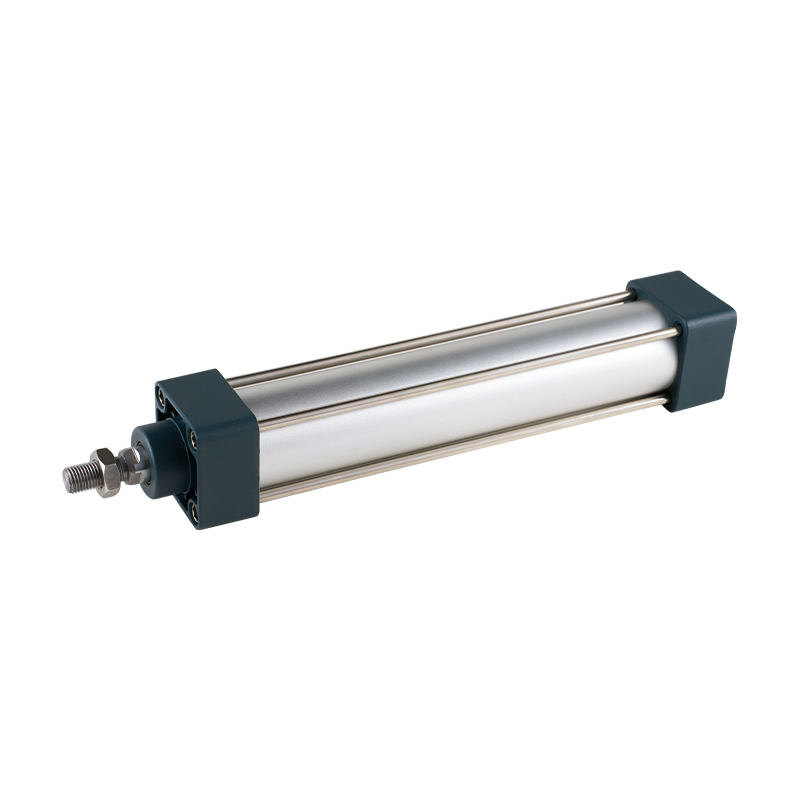 SC Series (Tie Rod Type) Standard Cylinder Suppliers, OEM/ODM Factory - ZhejiangCKT Pneumatic is a China wholesale SC Series (Tie Rod Type) Standard Cylinder suppliers and OEM/ODM factory, 1. The piston seal adopts a ...View Product →
Square and rectangular barrels
Square or rectangular aluminum profiles are typical for rodless and some no-tie-rod cylinders. The square outer shape makes it easier to mount sensors, guide rails, or brackets directly on the barrel. The inner bore remains round, but the outer geometry is extruded with slots and grooves for accessories.
Compact and Mickey Mouse profiles
Compact cylinder barrels, often called Mickey Mouse profiles because two round bore lobes appear side by side in a twin-rod version, are designed for short-stroke, space-limited automation. The popular CQ2 and SDA families use this type of aluminum extrusion. These cylinders save up to 40 percent of the mounting length compared with a standard cylinder of the same bore. For a compact actuator with a lightweight aluminum barrel, review CQ2 series compact pneumatic cylinders.
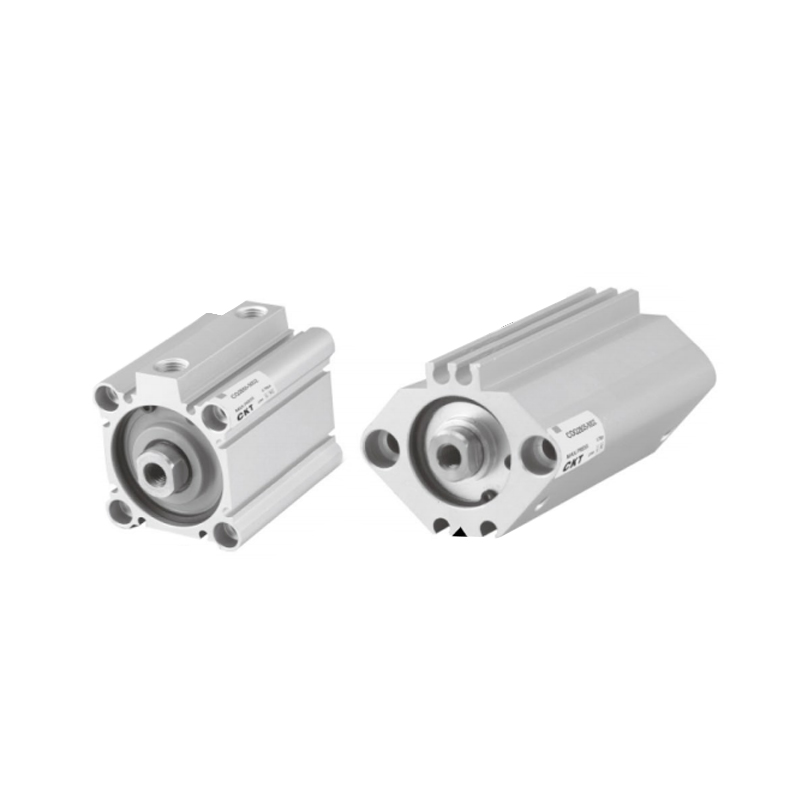 CQ2 Series Thin Cylinder Suppliers, OEM/ODM Factory - Zhejiang CKT Pneumatic Co.CKT Pneumatic is a China wholesale CQ2 Series Thin Cylinder suppliers and OEM/ODM factory, 1. The magnetic switch does not protrude: prev...View Product →
Miniature and guided barrel profiles
Miniature cylinders use small round aluminum or stainless steel barrels between 6 mm and 25 mm bore. Guided cylinders combine a barrel with linear guide shafts, and the barrel profile may have integrated guide rod channels. For compact automation, food handling and light assembly tools, the MAL series aluminum alloy mini cylinders are a typical example of a lightweight, round-barrel mini actuator.
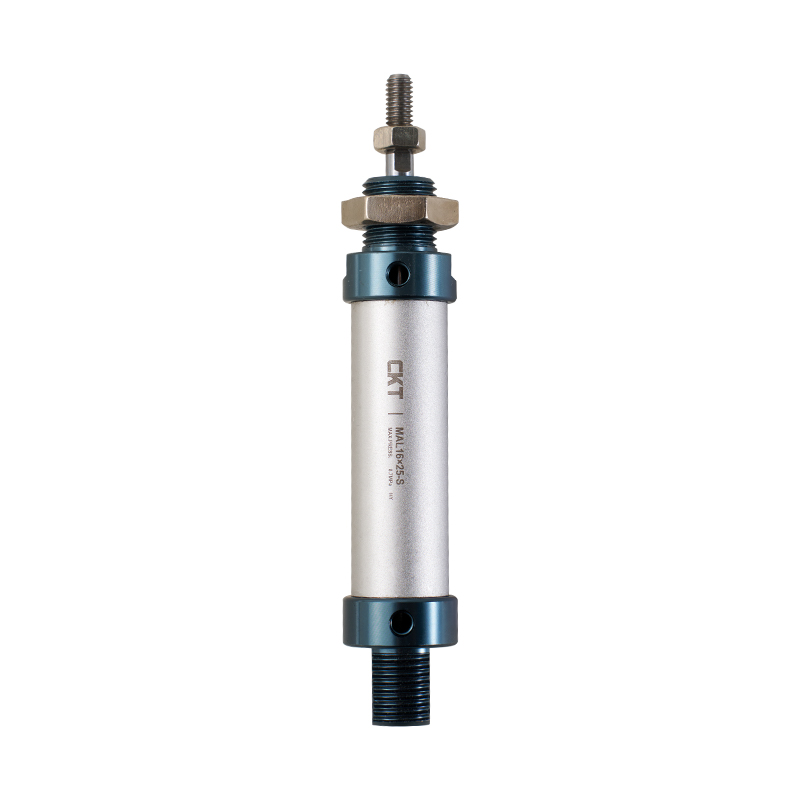 MAL Series Aluminum Alloy Mini Cylinder Suppliers, OEM/ODM Factory - Zhejiang CKCKT Pneumatic is a China wholesale MAL Series Aluminum Alloy Mini Cylinder suppliers and OEM/ODM factory, 1. Implement the company's stan...View Product →
How a Pneumatic Cylinder Barrel Is Manufactured
The manufacturing route for an aluminum pneumatic cylinder barrel is different from a steel barrel, and the finishing steps decide the bore quality.
- Aluminum extrusion. A heated aluminum billet is pushed through a die to create the barrel profile. Round and compact profiles come out of this step with a rough inner surface.
- Cutting and straightening. Extruded tubes are cut to length, and straightness is corrected because the extrusion process can introduce slight bending.
- Rough boring or reaming. The inner diameter is opened to close to the final size and remove extrusion marks.
- Precision finishing. The bore is either honed with abrasive stones or roller-burnished with a smooth rolling tool. Honing removes material, while roller burnishing compresses the surface. Both methods improve roundness and reduce surface roughness to the desired range.
- Surface treatment. Aluminum barrels receive anodizing to protect the outside; some barrels also get a coating on the bore to reduce friction and wear.
- Final inspection. The barrel is checked for inner diameter, roundness, straightness, and surface finish before it goes to the cylinder assembly line.
Steel and stainless steel barrels follow a similar path, but the starting point is usually a drawn seamless tube instead of an extruded profile. The tube is honed to final size, and some heavy-duty barrels receive a hard chrome plating on the bore to improve wear resistance.
In-house machining control matters here. Zhejiang CKT Pneumatic Co., Ltd. reports that its semi-finished warehouse holds more than 20,000 component types and that more than 90 percent of those parts are produced and processed internally. That level of vertical integration gives the company direct control over barrel machining and surface quality, rather than relying on an outside tube supplier for every batch.
Key Tolerances and Surface Specifications for a Pneumatic Cylinder Barrel
The drawing of a pneumatic cylinder barrel usually lists four or five critical parameters. You should ask your supplier for actual measurement reports instead of accepting a general claim of quality.
| Parameter | Typical industrial value | Why it matters |
|---|---|---|
| Inner diameter tolerance | ISO H7 for precision, H8 for standard | Controls the seal compression and piston guidance |
| Surface roughness (inner bore) | Ra 0.2 to 0.8 microns | Lower roughness means less friction and longer seal life |
| Roundness | Within 0.02 to 0.05 mm on precision tubes | Ovality causes uneven wear and erratic piston speed |
| Straightness | About 0.1 mm per meter for standard grades | Prevents piston rod side load and internal contact |
| Wall thickness uniformity | Kept uniform along the entire length | Supports equal clamping force and pressure resistance |
A simple shop-floor check is to measure the bore with a bore gauge at three positions along the barrel length and at two angles per position. If the readings change by more than 0.05 mm, the barrel should be rejected for precision cylinder service. Surface roughness can be checked with a portable profilometer; the stylus should travel along the axis of the bore, not around the circumference.
Selecting the Right Pneumatic Cylinder Barrel for Your Application
Selection starts with the required output force, not with the barrel profile. The theoretical force of a cylinder is the air pressure multiplied by the effective piston area. At a common industrial pressure of 0.5 MPa, the following forces are available from a few standard bore sizes.
| Bore size (mm) | Piston area (mm²) | Theoretical push at 0.5 MPa (N) |
|---|---|---|
| 16 | 201 | 100 |
| 32 | 804 | 402 |
| 50 | 1963 | 982 |
| 80 | 5027 | 2513 |
For practical machine design, use a load factor of 0.5 to 0.7 of the theoretical force. This safety margin covers friction, pressure fluctuations, and the deceleration force at the end of the stroke.
Other selection factors that involve the barrel directly
- Mounting style. Tie-rod cylinders need a round barrel with enough space for the rod bolts; compact cylinders use a flat or profiled barrel to reduce height.
- Stroke length. Long-stroke cylinders must be checked for barrel straightness, because a bent barrel causes high friction and heat.
- Environment. High humidity, chemical washdown, and outdoor operation push you toward stainless steel or a properly anodized aluminum barrel.
- Speed control. High-speed cycling generates heat; aluminum dissipates it faster, so an aluminum pneumatic cylinder barrel is often the better choice for fast pick-and-place modules.
What to Evaluate When Sourcing Cylinder Barrels from a Manufacturer
When you source a pneumatic cylinder barrel directly from a manufacturer, you should verify three capabilities: extrusion or tube sourcing, precision bore finishing, and quality measurement. A factory that only assembles cylinders from purchased barrels has limited control over the most critical parameter, the internal bore.
Ask for the bore gauge readings, surface roughness values, and leakage test records for the finished cylinder. Also ask how the supplier handles customization: bore size changes, custom stroke lengths, special port positions, and surface treatment options are common requirements in automation equipment.
Zhejiang CKT Pneumatic Co., Ltd., which started cylinder mass production in 2013 after building its pneumatic component line since 2002, is an example of a manufacturer that emphasizes in-house production. The company says more than 90 percent of its semi-finished components are processed internally from a base of over 20,000 parts. For a wider view of the available options, you can review the standard pneumatic cylinder lineup and compare barrel types before you specify a part number.
Keep the purchasing decision aligned with the machine requirement: request samples or a small trial order first, measure the bore, and run a cycle test before committing to bulk supply. That approach catches barrel quality issues before they affect your production line.
Frequently Asked Questions About Pneumatic Cylinder Barrels
Is a pneumatic cylinder barrel the same as a cylinder tube?
Yes. The terms are used interchangeably in the pneumatic industry. A cylinder barrel, cylinder tube, or air cylinder barrel all refer to the main cylindrical body in which the piston moves. Some suppliers use tube for the raw extruded or drawn product, and barrel for the finished machined component.
Why is the inner surface of an aluminum cylinder barrel honed or roller-burnished?
The raw extruded aluminum surface has extrusion lines and roughness that would damage seals and create friction. Honing removes the damaged layer and creates a true cylinder geometry; roller burnishing smooths the surface and compresses the material, increasing hardness and wear resistance. Both processes reduce friction and enable consistent piston movement.
Can I replace a steel cylinder barrel with an aluminum one?
Not automatically. You need to check the pressure rating, operating temperature, mounting type, and required service life. Aluminum is lighter and has better heat conduction, but steel is stronger and more resistant to impact and wear in heavy-duty applications. A replacement barrel should always be matched to the original cylinder design and tested under the real operating pressure.
What does a Mickey Mouse pneumatic cylinder barrel look like?
A Mickey Mouse barrel profile has two round bore spaces connected in a single extrusion, resembling two lobes. It is commonly found in compact twin-rod cylinders or cylinders with integrated guide rods. The shape saves space compared with two separate round barrels and increases the resistance to non-rotating loads.
How do I measure the bore of a pneumatic cylinder barrel?
Use a two-point bore gauge or a dial bore gauge. Measure in at least three positions along the barrel length, and take two readings at each position, one at 0 degrees and one at 90 degrees. Compare the readings to check roundness and taper. For a precision cylinder barrel, the difference should be within a few hundredths of a millimeter.